Electrifying Your Luxury Fleet: A Practical Guide to EV Limousines & Charging ROI
As multinational corporations tighten their ESG (Environmental, Social, and Governance) mandates, executive travel managers are under pressure to cut Scope 3 carbon emissions. For chauffeured fleet operators, transitioning to Electric Vehicles (EVs) is no longer just a marketing angle—it is becoming a requirement to win enterprise RFPs.
Key Industry Insight: Corporate travel spending on sustainable ground transport is growing rapidly. Fleet operators deploying zero-emission vehicles report higher corporate client retention and stronger positioning when bidding for Fortune 500 contracts.
Top Executive EVs Compared for Luxury Operations
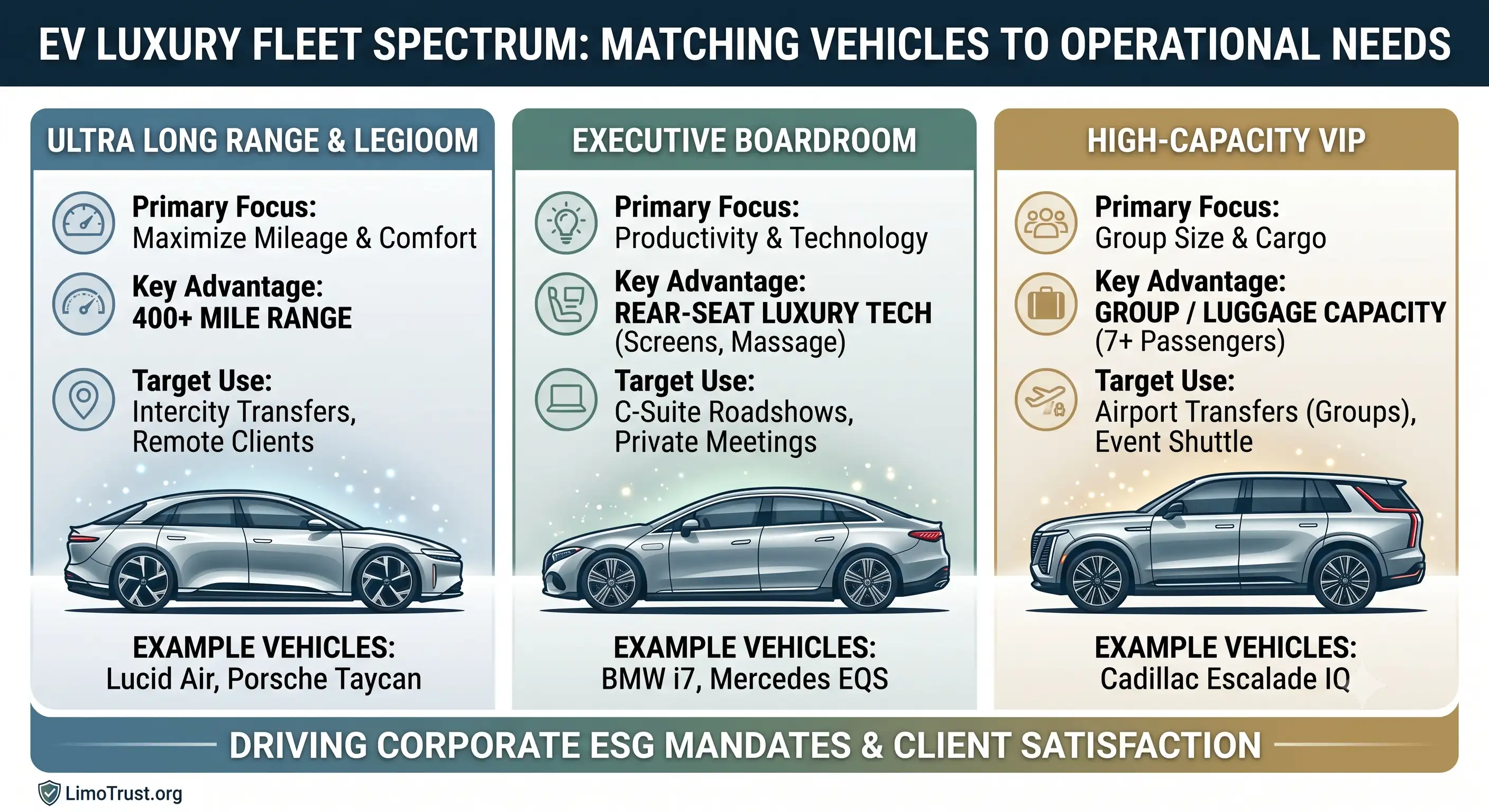
| Vehicle Model | Est. Real-World Range | Fast-Charging Capability (10-80%) | Key Executive Feature | Target Operational Use |
| Lucid Air Grand Touring | ~420 - 510 miles | ~15-20 minutes (350 kW DC) | Best-in-class rear legroom, whisper-quiet cabin | Long-distance intercity transfers |
| BMW i7 xDrive60 | ~290 - 318 miles | ~30 minutes (195 kW DC) | 31-inch 8K Theater Screen rear entertainment | High-profile VIP & C-suite roadshows |
| Mercedes-Benz EQS Sedan | ~300 - 350 miles | ~31 minutes (200 kW DC) | Executive rear seating package with massage functions | Corporate airport transfers |
| Cadillac Escalade IQ | ~450 miles | ~10 minutes for 100 miles (350 kW DC) | Full-size 7-passenger capacity with massive cargo space | VIP group & event transportation |
Calculating the Total Cost of Ownership (TCO) & Charging ROI
While luxury EVs carry a higher upfront acquisition cost, their operational expenditure (OpEx) is significantly lower than traditional internal combustion engine (ICE) luxury sedans like the Lincoln Navigator or Mercedes S-Class.
1. Operational Savings Analysis (Per Vehicle / 50,000 Miles Annually)
- Fuel vs. Electricity: Assuming gas at $\$4.20/\text{gal}$ (18 MPG average for ICE luxury SUV = $\$11,666$) versus commercial electricity at $\$0.16/\text{kWh}$ (average 2.8 mi/kWh = $\$2,857$). Annual Fuel Savings: ~$\mathbf{\$8,809}$ per vehicle.
- Maintenance & Service: Zero oil changes, fewer brake pad replacements due to regenerative braking, and zero exhaust system repairs save an estimated $\mathbf{\$2,200 - \$3,500}$ annually per unit.
2. Fleet Charging Infrastructure Strategy
To maximize vehicle uptime, operators should implement a two-tiered charging model:
-
Depot Level 2 AC Chargers (11 kW - 19.2 kW): Installed at the main fleet hub for overnight charging during off-peak rate hours (typically 11 PM to 6 AM).
-
Commercial DC Fast Charging Partnerships: Establish fleet accounts with networks like Electrify America or EVgo for quick mid-shift top-ups during peak airport dispatch hours.